
Structured perfumery programmes are easy to buy and harder to choose, because the formats differ in what they actually change rather than in how impressive they sound. For a drugstore own-brand team the useful question is not which programme is most prestigious but which format fixes the specific weakness on your side of the table — a buyer who cannot describe an intensity, a panel that keeps disagreeing, or a product team that approves scents it has never tested in a lotion. Paying for the wrong format costs the fee plus another season of slow decisions.
Key takeaways
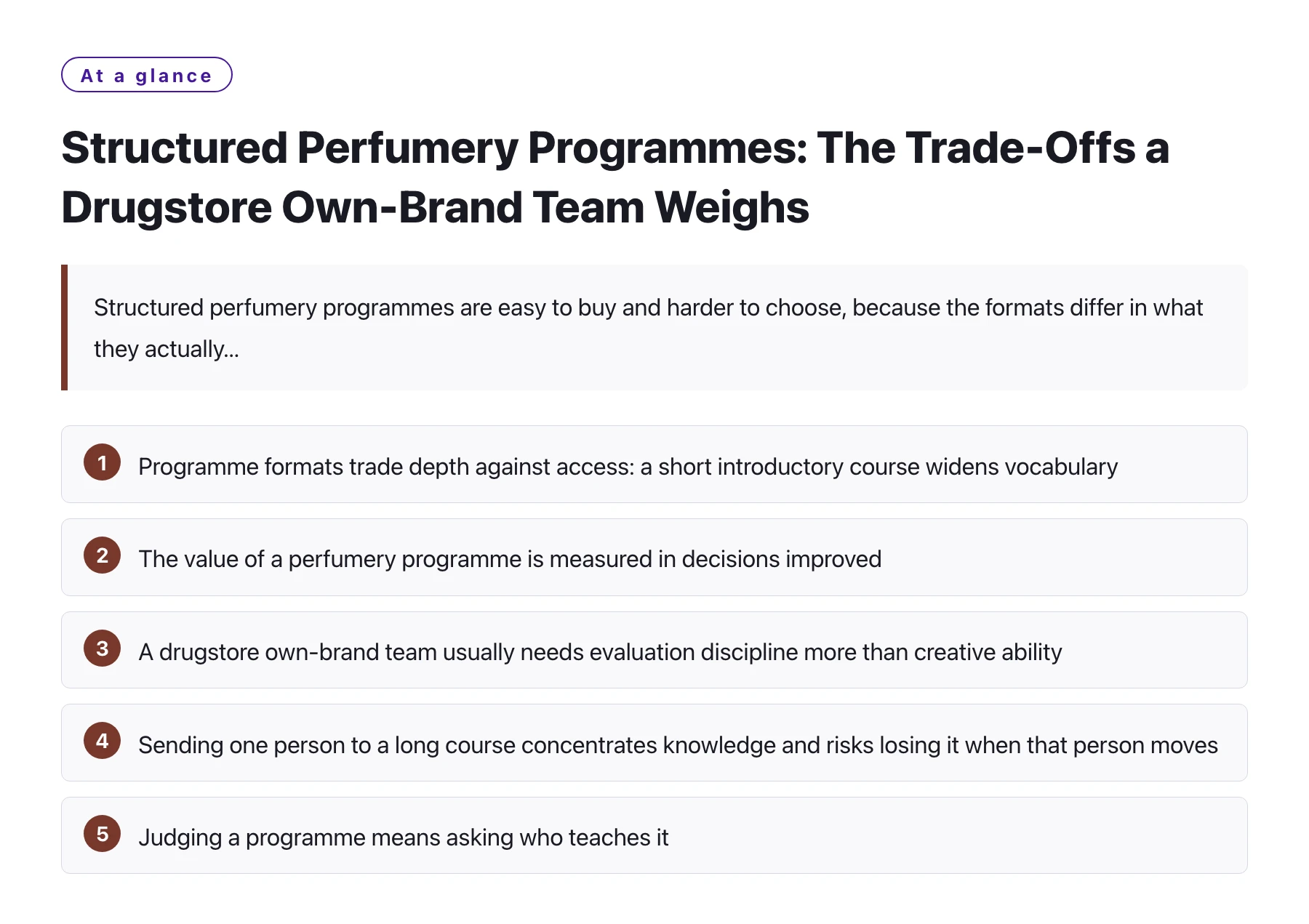
- Programme formats trade depth against access: a short introductory course widens vocabulary, a masterclass deepens judgement, and an in-house session changes how a specific team works together.
- The value of a perfumery programme is measured in decisions improved, not in certificates held, so define the decision you want to get better at before you book anything.
- A drugstore own-brand team usually needs evaluation discipline more than creative ability, because its job is to choose and defend a range at a price, not to compose a signature.
- Sending one person to a long course concentrates knowledge and risks losing it when that person moves; sending a whole team to a short session spreads a shared vocabulary but produces no specialist.
- Judging a programme means asking who teaches it, what the participants smell, and whether the assessment is against a reference standard or against each other.
Fragrance education in this industry comes in several shapes, and they are often marketed with the same adjectives. There is the introductory course that runs for a few days and teaches people to describe what they smell. There is the masterclass aimed at professionals who already have vocabulary and want judgement. There is the supplier-run session built around a particular house's materials and methods. And there is the bespoke in-house programme, which is usually the most expensive per head and the most specific to a company.
None of these is better in the abstract. They differ in where the time goes: into breadth of materials, into depth of a family, into a house's own practice, or into the way a particular team makes decisions together. That last distinction matters more than it sounds, because most of the friction in a drugstore own-brand programme is not a lack of knowledge. It is two functions — marketing and product development — using the same words to mean different intensities, and then discovering the disagreement four samples late.
Trade fairs, industry associations and training bodies all publish guidance on fragrance terminology and on how scent is assessed, and it is worth reading that material before comparing programmes, because it shows how much of the language is standardised and how much is a house convention [1]. The European industry body publishes similar material on how fragrance materials are evaluated for safety and how that work is communicated [2]. A team that understands the difference between a safety evaluation and a preference test will get more out of any course it attends.
Four formats, and what each one actually changes
| Format | Best suited to | Trade-off to accept |
|---|---|---|
| Short introductory course | Buyers and product managers with no shared scent vocabulary | Produces language, not judgement; participants can describe a scent but still not rank two directions |
| Professional masterclass | One or two specialists who will own evaluation for the brand | Depth for the individual, and knowledge that walks out of the door if that person leaves |
| Supplier-hosted session | A team that needs to understand one partner's materials and methods quickly | Framed by that supplier's practice, so it is useful for working with them and less portable elsewhere |
| Bespoke in-house programme | A team whose real problem is disagreement rather than inexperience | Highest cost per head and the most planning; the content has to be written around your own products |
| Conference and trade content | Keeping current with materials, regulation and market direction | Broad and shallow; good for awareness, useless as a decision framework |
The table is deliberately blunt, because most disappointment with fragrance training comes from buying a format for a problem it does not address. A team that keeps approving a scent in a bottle and rejecting it in a lotion does not need more vocabulary; it needs a testing habit. A team that cannot tell a supplier what it wants does need vocabulary, and a short course is the cheapest way to get it. Experience is worth weighing too: a provider that can point to Xuelei's 31 years in fragrance or an equivalent track record is easier to judge than one that describes its method only in the present tense.
What a drugstore own-brand team is actually buying
The channel shapes the requirement. A drugstore own brand competes on shelf presence, price architecture and consistency across many doors, and the scent decision has to survive a range review rather than a single hero launch. That means the skills that pay back are ranking, describing intensity in words other people can act on, and reading a formula or a specification well enough to ask a sensible question.
Creative perfumery skill, by contrast, rarely pays back for a retailer. A brand that starts composing its own accords is buying a capability it will use once and maintain forever. The realistic split is to own evaluation and brief-writing, and to buy composition — either from an independent perfumer or through a manufacturer's development team, where the same people who write the formula also run the production.
How to judge a programme before you pay
Three questions separate a serious programme from a pleasant afternoon. Who teaches it, and do they still work with materials rather than only with slides. What do participants actually smell, and is the material set broad enough to cover the families your shelf needs. How is progress assessed, and is it assessed against a reference standard or only against the opinions of the room.
A fourth question is about follow-up. A course that ends with a certificate and no further contact leaves the team with vocabulary it will partly forget within a quarter. Programmes that include a later assessment, a project or a refresher tend to hold, and they are usually the ones built by institutions with a longer teaching tradition rather than by a marketing department.
Where the programme sits in a project
Timing changes the return. Training a team before a development project starts tends to reduce sample rounds, because the brief is clearer and the feedback is more specific. Training a team after a launch goes wrong is useful but expensive, because the money has already been spent on samples the team could not evaluate.
It also helps to train on your own products. A generic material set teaches the nose; the same set alongside the ten products your brand already sells teaches the business. Teams that walk a supplier's collection with their own range in hand tend to come back with better questions than teams that go purely to broaden their exposure — an argument for pairing a course with a visit to a working collection such as Xuelei Fragrance Museum, where the material and the finished product can be compared in the same afternoon. The same pairing works when the teaching comes from a manufacturer that runs custom fragrance R&D and production alongside it, because the examples then come from live projects rather than from a slide deck.
Before booking anything, write down the one decision the programme is supposed to improve, and who will make it afterwards. If the answer is that the whole team will agree faster on which direction to take into a lotion, an in-house session on your own products will beat a prestigious course by a wide margin. If the answer is that one person will own evaluation for the next five years, send that person deep and give them a budget for materials to keep practising. A manufacturer that runs training alongside its development work, such as Xuelei fragrance education programmes built around a working perfumery, is often the cheapest way to combine both.
Sources
- The Fragrance Foundation —— A non-profit organisation for the fragrance industry, running perfumery education programmes and industry recognition.
- Cosmetics Europe —— The European trade association for the cosmetics and personal care industry, publishing guidance, positions and market information.
Frequently asked questions
How long does a useful perfumery programme need to be?
Long enough to smell a broad material set more than once and to be assessed. A single afternoon can introduce vocabulary, but retention usually depends on repetition and on follow-up. Programmes measured in days rather than hours tend to produce people who can rank directions consistently, which is the skill most brand teams actually need.
Should a drugstore own brand send one person or the whole team?
It depends on the bottleneck. If decisions stall because functions disagree, the whole team needs a shared language and a short session is enough. If the brand needs someone who can hold a technical conversation with a perfumer, one person on a longer programme is the better use of the budget. Doing both in the same year is rarely justified.
Is a supplier-run course as good as an independent one?
They answer different questions. A supplier session is fast and specific to the materials and methods you will actually use together, which makes it efficient for a live project. An independent programme is broader and more portable, which matters if you expect to change suppliers or to build an internal capability that outlasts a relationship.
Can training replace a professional evaluation panel?
No, and it is worth being clear about that internally. Training improves the people who make commercial decisions about scent; it does not turn a product team into a sensory panel with statistical rigour. For claims that need defensible data, consumer or trained-panel testing is a separate purchase with its own design.
What is the cheapest way to raise a team's scent judgement?
Buy a material set, agree on a written vocabulary, and evaluate your own products against it every month. That costs very little and builds the habit that courses depend on. Formal programmes then add structure, assessment and exposure to materials a team would not otherwise encounter, which is where their fee is genuinely earned.