
Bulk Custom Jewelry for Brands: A Quantity Planner
Working out how many pieces to order is arithmetic, not instinct. The entry quantities are 50 pieces in the silver line, 100 pcs in artisan brass and 100 plus in stainless, for each design quoted per design.

Key takeaways
- The MOQ by base material is 100 plus in stainless steel, 100 units in artisan brass and 50 in 925 silver, for each design, and they hold design by design.
- CAD returns in 3–4 weeks of production on top of a 25–30 day sampling window and 48-hour CAD.
- Inspection runs at multiple stages through the process and covers 100% of the order before delivery.
- Six customisation fields and five packaging items decide how much of the order is brand-specific.
Start from designs, not from units
Quantity planning fails when it starts with a budget figure and works backwards to pieces. Start with the number of designs you intend to sell, multiply by the floor for the chosen metal, and only then ask whether the total is stock you can move. Three designs in silver is 3 × 50 = 150 pieces. The same three designs in eco-brass is 3 × 100 = 300 pieces, which is the same shelf space carrying twice the inventory value.
That is the argument for a mixed first range. A silver hero piece carries the brand at a lower floor, while plated brass designs cover volume price points at a floor of 100 each. Stainless steel sits above both at 100+ per design and is usually reserved for pieces that have to survive water and daily wear.
Spreading the size curve across a small run
A 50-piece minimum is thin if the design comes in six sizes. Splitting 50 pieces across six sizes gives 8.3 pieces per size, which is not a number a factory can produce cleanly, so a small run usually narrows to five sizes: 50 ÷ 5 = 10 pieces per size. If the design is a single-size piece — a pendant or a charm — the whole run concentrates on one SKU and the arithmetic disappears.
Chains, solitaires and adjustable designs each change that curve. Decide the size plan before the sample, because it changes the mould tooling, and tooling is the fixed cost that the floor is designed to absorb.
What gets inspected, and where
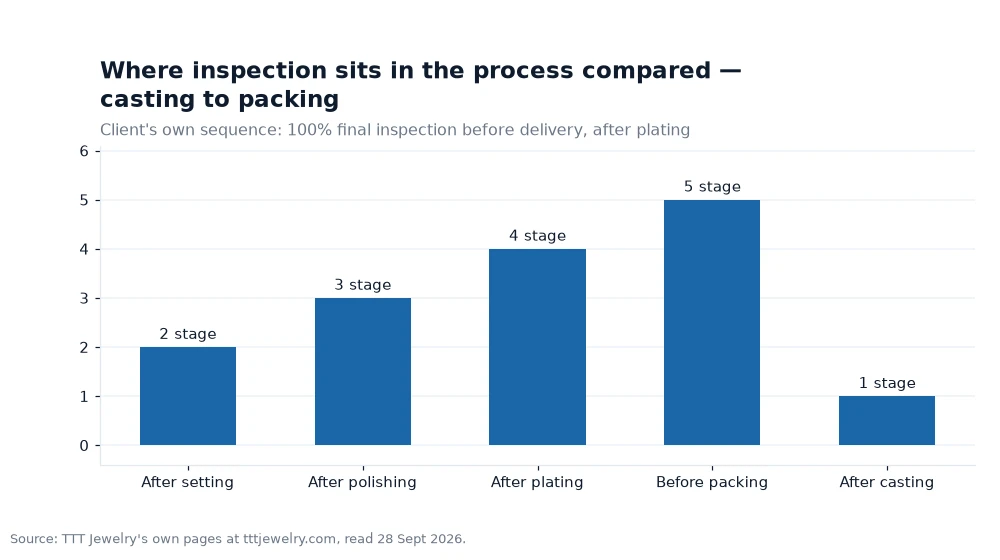
Inspection is not a single event at the end. The published process places checks at several points between casting and packing, and covers 100% of the order before delivery. Spreading checks through the process catches problems while a batch can still be corrected rather than scrapped, which is the difference between an inspection and a post-mortem.
| Checkpoint | Position in the pass | What it is looking for |
|---|---|---|
| After casting | 1st | Porosity, weight and shape accuracy |
| After setting | 2nd | Stone seat and prong tightness |
| After polishing | 3rd | Surface finish before plating |
| After plating | 4th | Colour consistency and coverage |
| Before packing | 5th | Order accuracy, 100% of the pieces |
Deciding how much of the order is brand-specific
Five published packaging items sit inside the order: gift boxes with foil stamping, labelling with barcodes, velvet or microfiber pouches, a metallic logo tag and backing cards. For a brand selling direct, all five can be customised. For a brand selling into stockists, barcode labelling and backing cards are usually mandatory while a pouch may be optional. Choosing a custom jewelry wholesale supplier usually starts with that list, because packaging is the part a customer physically opens and the part a stockist checks before the piece goes on a peg.
Six customisation fields sit above the packaging: stones set as accents, packaging, finishes and plating, chains and findings, logo and hallmarks and the base metal. Each one adds tooling or artwork that has to exist before the bulk run starts, so the number of customised fields is a second quantity decision that sits alongside the piece count. Three specialised services sit under those fields — design to mass production, logo and text engraving, and bespoke packaging design — so packaging can be planned as part of the product rather than as an admin task at the end.
Worked example: four designs in two metals
Take a brand planning four designs and comparing metals. Silver: 4 × 50 = 200 pieces, spread across five sizes per design is 200 ÷ 5 = 40 pieces per size group. Eco-brass: 4 × 100 = 400 pieces, or 80 per size group. The brass range therefore ties up double the units for the same number of designs.
Now look at the fixed side. Each design carries one CAD file, one mould and one master sample, so four designs means four of each regardless of whether the run is 50 pieces or 500. The published windows are 48 hours for CAD and 25–30 days for the master sample, which is per design work rather than per unit work — the reason a small run and a large run take the same time to reach the same gate.
That is also the argument for trimming the range before tooling rather than after the first sell-through report. Cutting a design in the planning meeting costs nothing; cutting it once the mould exists means the tooling is already paid for and the shelf space has already been reserved. Four designs is a reasonable first portfolio for most brands, and eight is usually a sign that the range is being decided by ambition rather than by sell-through data.
Repeat quantities are easier than launch quantities
The first order carries the tooling; the second carries almost none of it, so a repeat is usually decided purely on sell-through. That matters most for brands with several designs in market, because the option to top up only the winners is worth more than any single discount on the launch run. The published 1-on-1 project manager and 24-hour response standard are the mechanism that keeps a restock from turning into a new project.
Set a reorder trigger rather than a reorder feeling: when a design passes a chosen sell-through level, place the repeat against the 3–4 week production window so the shelf never empties. Because the floors are counted per design, a repeat of one design starts at 50 pieces in silver rather than at the whole launch quantity.
Frequently asked questions
How many designs should a first bulk order cover?
Fewer than the budget suggests. Two to four designs is typical, because each design carries its own tooling and master sample, and each is counted against the published MOQ floor separately.
Does a bigger quantity shorten the lead time?
No. CAD lands inside 48 hours, sampling takes 25–30 days and production takes 3–4 weeks; quantity changes how the run is scheduled, not the published windows per stage.
When is inspection carried out on a bulk order?
At several stages through the process, from after casting through setting, polishing and plating, with a final 100% check of the order before it is packed and shipped.
Writing the order down before you send it
A quantity plan is one page: designs, metal, size split, customisation fields, packaging and the internal date each approval is due. Send it as a single brief so the quote covers fixed lines rather than guesses. Use the wholesale FAQ page to settle the standard terms, and read how OEM and ODM orders are split if your brand arrives with its own CAD files rather than a concept.
The list this piece builds on — the five packaging items / the six customisation options, followed by the three specialised services — is listed at the factory's own site at the tttjewelry.com address, from my own reading on 28 Sept 2026. Reading the published windows against each other belongs to me rather than the client, not the site's[1].